Humility and Holiness: Reaching the Spiritually Open, Church-Averse Generation
Reaching the Spiritually Curious, but cautious in Society
America’s religious landscape is shifting. A growing share of our neighbors now identify as religiously unaffiliated—often called the “religious nones.” Many are not hostile; they’re spiritually curious yet institution-cautious. According to the Pew Research Center, this religiously unaffiliated population “is the world’s third-largest religious category, after Christians and Muslims.” So how does the church reach seekers who value authenticity and meaning but resist formal religion?
Scripture gives us a threefold path: live with the humility and holiness of Jesus, engage in persistent, Scripture-shaped prayer, and move toward the “nones” with incarnational presence and a clear gospel. These aren’t optional strategies; together they form the pattern of Christian mission in a skeptical age.
If you find this post helpful, please support these ministry efforts by buying a copy of my book: The Bible Made Simple and Easy: Book‑by‑Book Summaries of All 66 Books with Visual Aids and Key Verses. Available in the shop and on Amazon. Get your copy today!
Why Humility, Holiness, and Prayer Belong Together
Humility and holiness are inseparable qualities in the life of the believer. When fused with prayer, these traits reflect the very character of Christ. Our approach must echo this Christian unity—since divided virtues can unwittingly reinforce cultural skepticism toward faith communities. The spiritual hunger around us is best met not by arguments, but by a compelling integrity that threads humility and holiness together, shaping our mission and witness.
Start Where Jesus Starts: Incarnation, Empathy, and Obedience
Our mission begins not with techniques but with a Person. The Son of God came near. He took on our humanity, shouldered our needs, entered our griefs, worked with His hands, and was tempted as we are—yet He remained without sin (Hebrews 4:14–16). The One who emptied Himself and became obedient to death (Philippians 2:5–11) is our model for engaging a world that is suspicious of power and hungry for integrity.
This means our tone matters as much as our content. Christ’s humility doesn’t dilute holiness; it makes holiness visible and beautiful. As our sympathetic High Priest, Jesus invites us to “draw near with confidence” in prayer—and then He sends us to draw near to our neighbors with that same empathy and courage. The way we carry the gospel must reflect the One we proclaim.
Pray Aggressively: “Your Kingdom Come, Your Will Be Done”
Jesus taught us to ask, “Your kingdom come, your will be done, on earth as it is in heaven” (Matthew 6:9–10). Prayer is not passive resignation; it is kingdom alignment. It is how we resist the world’s broken systems, push back darkness, and welcome Christ’s reign into specific lives and places. Jesus told us to pray and not lose heart (Luke 18:1). That’s aggressive prayer—bold, persevering, and anchored in Scripture.
Practices of Persistent Prayer
- Word-shaped intercession: Let Psalm 119 tutor your desires. Pray for your own heart—and for seekers—to love God’s Word, delight in His commands, and walk in righteousness.
- Targeted petitions: Name a person, coffee shop, campus, or neighborhood. Pray specifically for open doors, soft hearts, wise words, and divine appointments. Ask the Lord to “hallow His name” there.
- Persevering warfare: Spiritual conflict is real. Persist in asking God to dismantle lies, break chains, and expose counterfeits while protecting people from the evil one.
- Obedient follow-through: Prayer doesn’t replace obedience; it fuels it. When you sense a nudge to text, invite, share, or serve—do it.
Meeting the “Nones” With Incarnational Presence
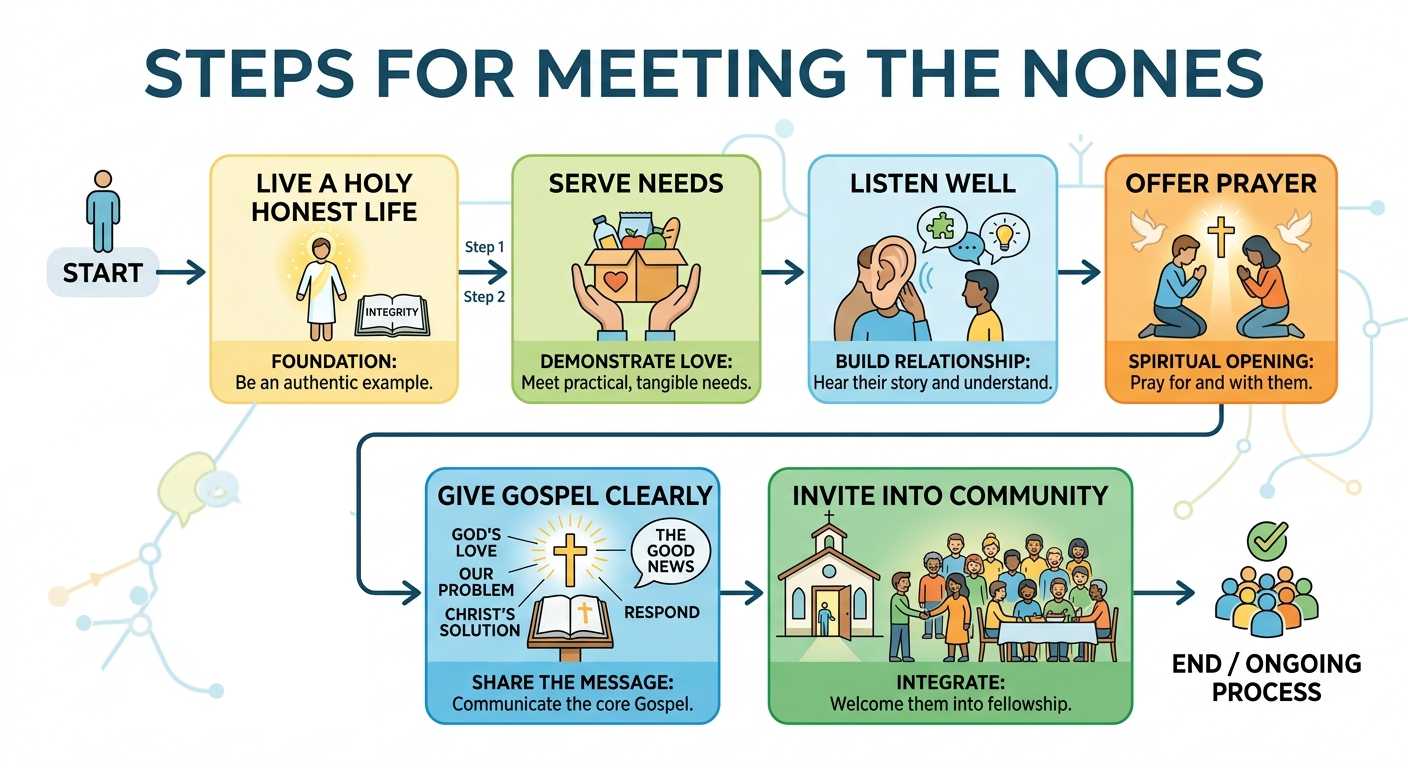
Many unaffiliated people still pray, still wonder, and still ache for transcendence. They may distrust institutions but long for credible community. Humility and holiness open doors that arguments can’t. Here’s a simple framework to embody the gospel where you live, work, and play:
- Listen well before speaking. Ask sincere questions. What do they believe is “the good life”? Where have they felt God nearby—or far away? Listening is not agreement; it’s honor.
- Live a holy, honest life. Integrity is magnetic. Repent quickly. Keep promises. Honor your marriage. Speak truth without snark. Holiness attracts the spiritually hungry.
- Offer prayer, not pressure. “Could I pray for you right now?” is often welcomed. Keep it brief, compassionate, and Christ-centered. Expect God to move.
- Give the gospel clearly. In natural moments, explain who Jesus is—fully God, fully man; crucified for our sins; risen to reign—and how we respond: repentance and faith. Keep the spotlight on Jesus, not church programs.
- Invite into community. Open your table. Introduce them to ordinary Christians who love Scripture and people. Consider third spaces (parks, cafes) for first steps.
- Serve practical needs. Meet tangible burdens without strings. Authentic love gives credibility to a countercultural message.
Truth and Tenderness: No Longer a Tug-of-War
Many believers feel an internal tug-of-war: if I’m tender, will I compromise truth? If I’m bold, will I crush bruised reeds (or discard the weak, broken, or struggling – see Isaiah 42:3)? In Jesus, truth and tenderness are not rivals. The One who calls sin what it is also eats with sinners. The One who commands obedience also carries our sorrows. The result is a compelling integrity of life: humility without compromise, conviction without contempt.
That same integrity must animate our mission. If we ignore holiness, we lose credibility. If we neglect humility, we lose people. But when humility and holiness converge—and are bathed in persistent prayer—the church recovers a distinctly Christlike presence in a cynical world.
Five Next Steps for Churches and Small Groups
- Adopt a prayer map. Identify a local web of “nones” (apartment complexes, colleges, coworking spaces). Pray over this map weekly, by name and place, asking for God’s will to be done there.
- Train in conversational evangelism. Practice two-minute testimonies and simple gospel outlines. Keep it relational, not rehearsed. Anchor everything in Scripture.
- Host honest forums. Offer Q&A nights where no question is off-limits. Lead with empathy; land with the cross and resurrection.
- Create low-bar onramps. Organize meals, service projects, and discussion groups in neutral spaces. Let belonging and conversation precede attendance.
- Mobilize intercessors. Build a praying core that fasts, intercedes, and follows up. Consider resources like Operation World’s prayer guides to catalyze focus and faith.
A Simple Prayer for a Skeptical Age
Father in heaven, hallowed be Your name in my city. Your kingdom come, Your will be done in my home, my workplace, and among those who feel far from church. Lord Jesus, our sympathetic High Priest, teach me Your humility and Your holiness. Give me courage to love, wisdom to listen, and clarity to speak. Spirit of God, open eyes to see Jesus, cast down every lie, and draw seekers into the joy of repentance and faith. Make us a people of the Word and prayer, steadfast and gentle, bold and kind. For the glory of Christ. Amen.
Keep the Long View
Reaching the spiritually open but church-averse won’t be solved by one viral strategy or one clever series. It takes incarnational patience, Scripture-shaped obedience, and persevering prayer. The good news? Jesus has already walked this road. He’s not asking us to manufacture a mission; He’s inviting us to join His.
Take heart. The Lord of the harvest has placed you—and your church—here for such a time as this. Draw near to the throne of grace with confidence, then draw near to your neighbors with the same grace you’ve received. In that sacred overlap—humility with holiness, prayer with presence—the kingdom comes, and seekers meet the Savior.
Author

Discover more from Elkleaf Publishing
Subscribe to get the latest posts sent to your email.