Pray, Posture, Practice: A Credible Witness in a Skeptical Age
Many of our neighbors don’t check a box for organized religion anymore, but they aren’t immune to spiritual curiosity. In fact, a growing share of Americans identify as religiously unaffiliated yet remain open to meaning, transcendence, and community. Recent research notes nearly three-in-ten U.S. adults now fall into this category, even as many still pray or say they believe in “something more.” See this Data from the 2025 PRRI Census of American Religion for details.
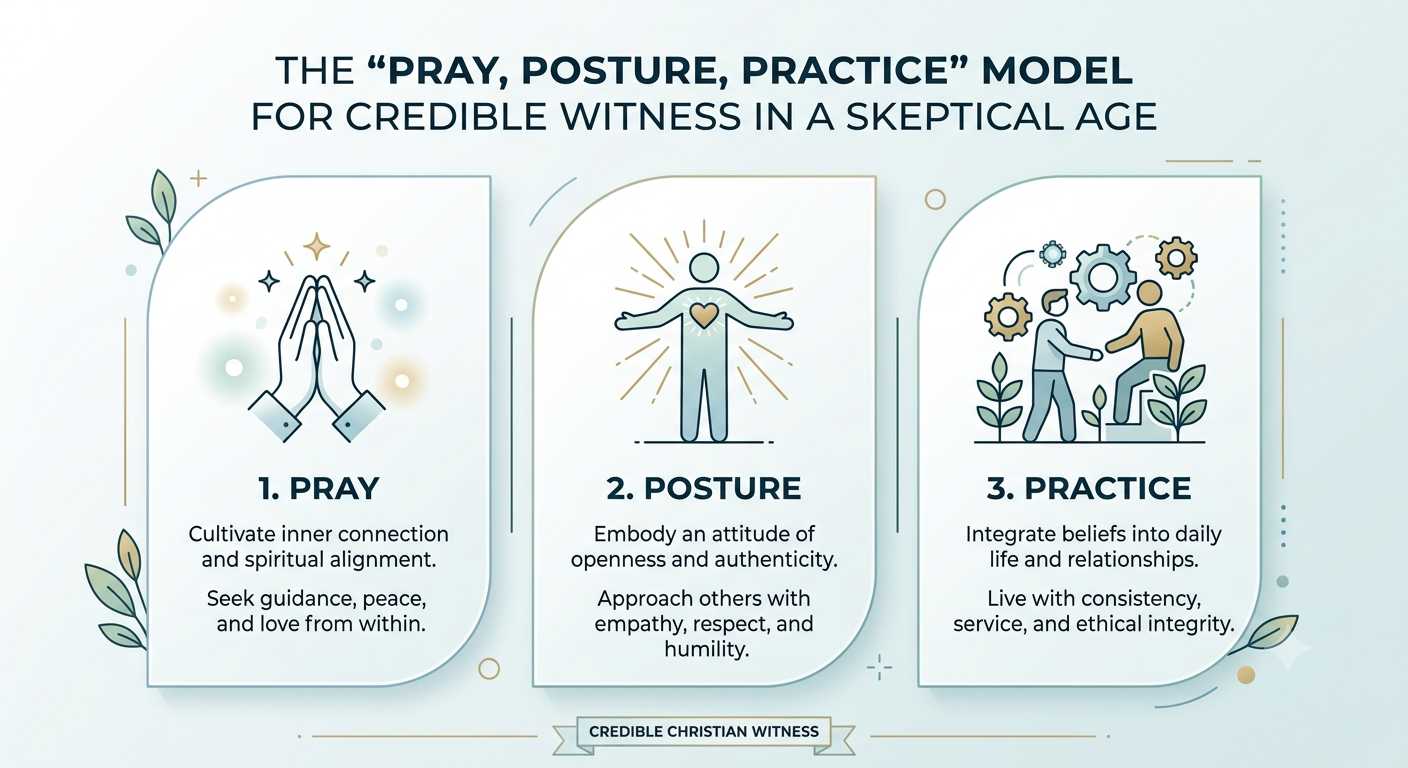
How should the church respond in a way that’s faithful and fruitful—credible and compelling? Scripture gives us a simple, strenuous path: pray the Lord’s Prayer with integrity, adopt the humble posture of Christ, and practice sacrificial love toward our neighbors. In short: Pray. Posture. Practice. This approach builds a credible witness in a skeptical age, authenticating faith through actions and attitudes grounded in the gospel.
If you find this post helpful, please support these ministry efforts by buying a copy of my book: The Bible Made Simple and Easy: Book‑by‑Book Summaries of All 66 Books with Visual Aids and Key Verses. Available in the shop and on Amazon. Get your copy today!
Pray: The Disciples’ Prayer as Our Daily Agenda
Jesus gave us more than words to recite in Matthew 6:9–13; He handed us a life-pattern that calibrates our hearts to God’s kingdom, power, and glory. When we say, “Our Father in heaven, hallowed be Your name,” we’re committing to holiness and obedience in the ordinary. When we pray, “Your kingdom come, Your will be done,” we’re aligning our priorities with God’s mission in the world—especially for those outside our circles.
- Dependence: “Give us this day our daily bread” forms humble reliance, not self-sufficiency. This is vital for authentic discipleship and witness.
- Forgiveness: “Forgive us our debts, as we also have forgiven our debtors” demands relational integrity. No credible evangelism without practiced forgiveness.
- Holiness under pressure: “Lead us not into temptation, but deliver us from evil” commits us to moral clarity and purity, even when culture shrugs.
- Doxology as direction: “For Yours is the kingdom and the power and the glory” reminds us: God provides the power, God sets the agenda, God gets the glory.
And Jesus prayed this way not only in teaching but in practice. In John 17, He prays for our protection, unity, and holiness so that the world may believe. Prayer is not a warm-up to mission; prayer is the engine of mission—fueling a credible witness in a skeptical age.
Posture: The Debt of Love in a Culture of Self
The Apostle Paul says there’s one debt we should never finish paying: “Owe no one anything, except to love each other” (Romans 13:8). This love is not sentimental; it is Spirit-enabled and Christ-shaped. “God’s love has been poured into our hearts through the Holy Spirit” (Romans 5:5), and it looks like humility and service.
Consider the pattern of Jesus: “Have this mind among yourselves… He humbled Himself” (Philippians 2:5–8). This posture heals the credibility gap. In a climate where pride, performative outrage, and partisanship dominate, tenderness and gentleness stand out. The New Testament calls us to:
- Put others first (Galatians 5:13): Use freedom to serve, not to win.
- Forgive and be kind (Ephesians 4:32): Soft hearts, not sharp elbows.
- Protect consciences: Don’t cause others to stumble; love limits liberty out of compassion for the neighbor.
- Imitate Christ’s sacrifice (1 John 3:16): Measure love by what it’s willing to give up.
- Live out brotherly love (1 Thessalonians 4:9): God Himself teaches us to love one another.
When a church embraces this posture, the message of grace starts to sound plausible again. The Spirit doesn’t just fill our services; He forms our habits. And that’s what the world notices, strengthening a credible witness in a skeptical age.
Practice: A Gentle, Gospel Presence Among Non-Christians
Relational evangelism may sound slow, but it is deeply aligned with the grain of the gospel. The apostle John says plainly: “We love because He first loved us” (1 John 4). For a skeptical neighbor, the most powerful apologetic may be a neighbor who shows up with compassion, integrity, and humble holiness.
Here are practices that put prayer and posture into motion for a credible witness in a skeptical age:
- Start with prayer, stay with prayer: Pray the Lord’s Prayer by name for three neighbors daily. Ask God for open doors and a servant’s heart (Matthew 6:9–13).
- Lead with listening: Curiosity disarms. Ask about their story. Don’t debate; discern. The goal is witness, not winning.
- Hospitality over hype: Share meals, not just memes. Ordinary tables become extraordinary places for gospel conversation.
- Offer practical kindness: Mow a lawn, watch kids, bring a meal. Love in action gives credibility to truth in words.
- Gently name Jesus: Don’t hide the gospel. Share how Christ’s forgiveness and transformation changed you.
- Keep integrity tight: If you pray “Your will be done,” then obey. If you ask for forgiveness, extend it quickly.
We’re not aiming for trendiness or compromise. We’re aiming for a steady, Spirit-empowered presence where holiness is beautiful and hope is believable—a credible witness in a skeptical age for our neighbors.
A 30-Day “Kingdom, Power, Glory” Experiment
Try this simple rhythm as a church, small group, or family. Let prayer fuel formation, and let formation propel mission, cultivating a credible witness in a skeptical age.
Week 1: Prayer and Dependence
- Memorize and pray Matthew 6:9–13 morning and evening.
- Fast one meal; pray for three neighbors by name.
- Journal daily: Where did I rely on God’s power today?
Week 2: Humility and Love
- Meditate on Philippians 2:5–8 and Romans 13:8.
- Perform two unseen acts of kindness. Don’t post about them.
- Make one reconciliation call. Seek or extend forgiveness.
Week 3: Hospitality and Witness
- Invite a neighbor or coworker to a meal. Ask good questions. Listen twice as much as you speak.
- Share a two-minute testimony: Who I was, how Christ met me, what’s changed.
- Pray together afterward, even if it’s brief and simple.
Week 4: Unity and Mission
- Read John 17 aloud with your group or family.
- Do a small service project with fellow believers; invite a neighbor to join.
- End the month by worshiping with robust doxology: “Yours is the kingdom and the power and the glory.”
Guardrails Against the Credibility Gap
Hypocrisy is a top complaint among seekers. Keep your integrity visible and verifiable as you aim for a credible witness in a skeptical age:
- Consistency check: Does my private life match my public prayers?
- Forgiveness first: Do I forgive as quickly as I ask God to forgive me?
- Holiness with humility: Am I pursuing purity without pride?
- Gospel clarity: Is Jesus central in my conversations, not just my church calendar?
None of this is accomplished by grit alone. We live and love by the Spirit. “We love because He first loved us” (1 John 4). The same Spirit who pours God’s love into our hearts empowers our obedience and sustains our witness as a credible witness in a skeptical age.
For His Kingdom, By His Power, To His Glory
When we pray the Lord’s Prayer with integrity, adopt Christ’s humility, and practice costly love, the church becomes both believable and beautiful. The unbelievers among us aren’t ‘just a nuisance;’ they are neighbors to be served in compassion, and souls to be invited into the life of the gospel. This is the heart of a credible witness in a skeptical age.
So let’s begin where Jesus taught us to begin. Let’s ask Him—again today—to align our lives with His kingdom, rely on His power, and aim at His glory. And then let’s step into our streets with prayerful dependence, humble posture, and practical love—so that our neighbors might see and say, “God is among them.”
Author

Discover more from Elkleaf Publishing
Subscribe to get the latest posts sent to your email.