Guarded by Truth, Driven by Love: A Roadmap for Church Health in Challenging Times
Church Health: A Christ-Centered Roadmap
We live in a moment where the church faces both internal strain and external skepticism. We’ve seen “worship wars,” doctrinal erosion, and a growing number of unaffiliated neighbors—the so-called “nones”—who are spiritually curious but church wary. How do we move forward with church health, unity, and authenticity in a way that’s true to the gospel and compelling to a watching world?
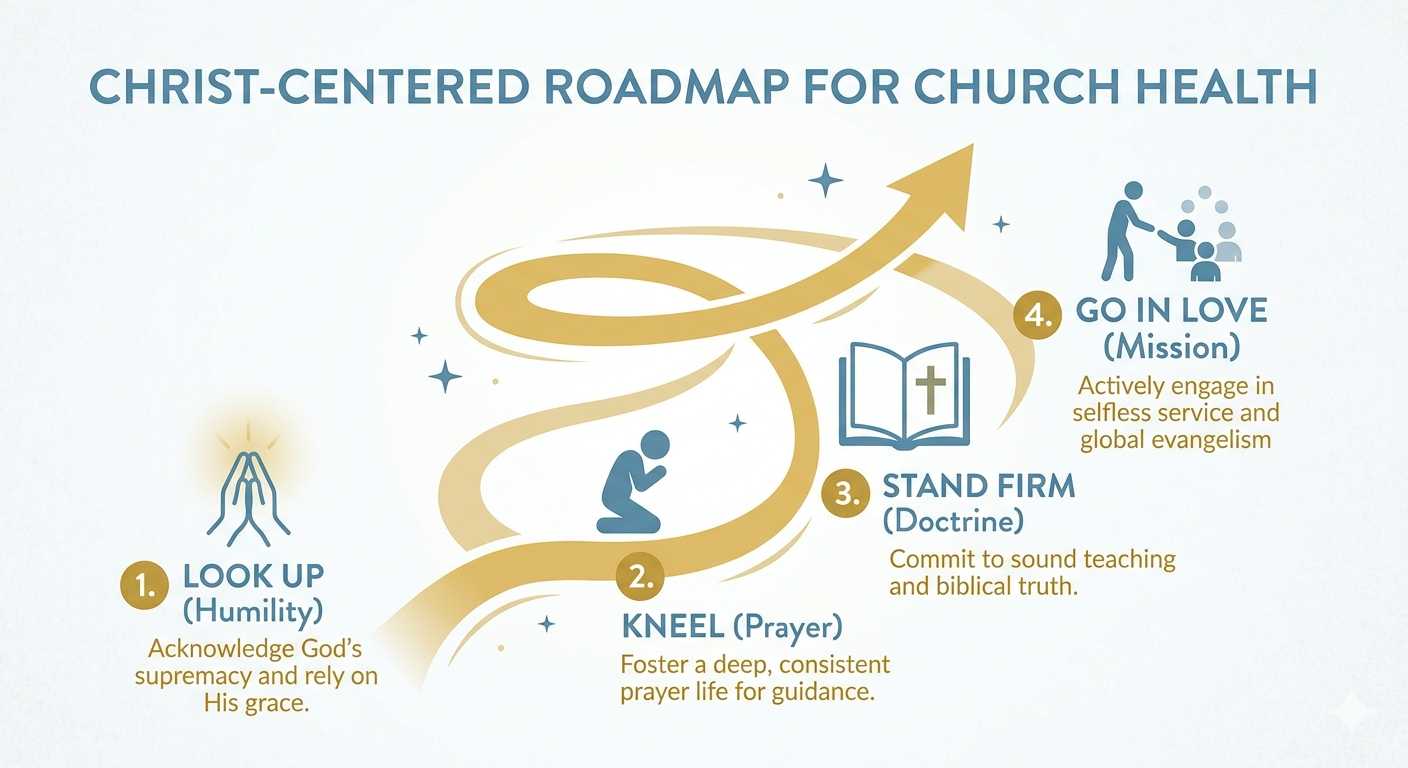
Scripture points us to a Christ-centered path: look up in humble awe, kneel in Jesus-shaped prayer, stand firm in sound doctrine empowered by the Spirit, and go to the world with resilient love. This is orthodoxy and orthopraxy together. It’s the narrow road where grace and truth walk in step. Focus on church health lays the foundation for a faithful and effective witness.
1) Look Up: Humility Begins with Christ-Awareness
Real Christian humility isn’t thinking less of ourselves; it’s thinking rightly about Christ—His deity, His perfection, His servant-heart. When Peter’s net overflowed at Jesus’ word, his first instinct wasn’t to brag but to bow: “Depart from me, for I am a sinful man” (Luke 5:1-11). Awe led to repentance, and repentance led to mission.
We’re called to “walk in a manner worthy of the calling” with “all humility and gentleness” (Ephesians 4:1-2), and to “walk in the same way in which he walked” (1 John 2:6). The One we follow is fully God and fully man, who “came not to be served but to serve” (Mark 10:45).
Humility check:
- Am I comparing myself to Christ, or to other Christians I can outpace?
- Does awe of Jesus regularly lead me to confession and obedience?
- Is my service patterned after His—quiet, sacrificial, joyful?
2) Kneel: Pray as Jesus Prayed
When the disciples asked, “Lord, teach us to pray” (Luke 11:1), Jesus didn’t give them a mantra to recite mechanically but a pattern to embody (Matthew 6:9-15). Notice the order: God’s name, God’s kingdom, God’s will—then our daily bread, our pardon, our protection. Prayer is first about God’s glory and only then about our good (see John 14:13).
The “Jesus pattern” for daily prayer:
- Name: “Father, hallowed be Your name.” Honor His holiness.
- Kingdom: “Your kingdom come.” Align with His mission.
- Will: “Your will be done.” Surrender our agenda.
- Provision: “Give us this day our daily bread.” Depend on His care.
- Pardon: “Forgive us our debts.” Confess freely; forgive freely.
- Protection: “Lead us not into temptation.” Ask for discernment and deliverance.
For a helpful overview of the Lord’s Prayer, see this article from Turning Point: How to Pray the Lord’s Prayer.
3) Stand Firm: Sound Doctrine and Authenticity, Empowered by God
Church health falters when we trade biblical truth for trend, or when we weaponize preferences in “worship wars” instead of guarding the gospel. Unity is not built on style, but on doctrine and Spirit-empowered authenticity that keeps us on mission. We need more than clever methods—we need God’s power, the very power that raised Jesus from the dead (Ephesians 1:19-20).
Three guardrails for church health:
- Orthodoxy: Hold fast to the apostolic gospel—Christ’s deity, His atoning cross, bodily resurrection, and salvation by grace through faith. No drift.
- Orthopraxy: Practice what we preach—humility, holiness, service, and peacemaking. No hypocrisy.
- Orthopathos: Cultivate rightly ordered affections—love for God and neighbor that shapes tone, not just talking points. No harshness.
This is the antidote to doctrinal erosion and performative faith. A church anchored in truth and animated by the Spirit becomes a stable lighthouse in stormy seas.
4) Go in Love: Mission in a Changing Culture
The mission field has moved next door. Many “nones” aren’t hostile; they’re searching. They’re open to spirituality but allergic to hypocrisy. Our posture must be clear-eyed and warm-hearted—grace and truth in the same breath. For context on the rise of the religiously unaffiliated, see the Pew Research Center’s Religion & Public Life hub.
The gospel holds together what our culture keeps ripping apart—holiness and love, justice and mercy. At the cross, God’s justice against sin and God’s love for sinners meet. “For God so loved the world…” (John 3:16). That is why we go: not to win arguments, but to win people to Christ.
A simple missional step this week:
- Identify one spiritually curious friend or coworker.
- Listen first—ask about their story and hopes, not just their beliefs.
- Share Jesus simply—His life, cross, and resurrection; how He met you in grace.
- Invite a next step—“Can I pray for you?” or “Would you read a Gospel with me?”
Clarity without combativeness. Conviction with compassion. That’s reaching the nones in a post-church culture.
5) Resilient Disciples Get Back Up
Abraham believed God, and it was counted to him as righteousness (Romans 4). His life wasn’t a straight line of triumph; it was grace-covered perseverance. That’s good news for stumblers like us. In Christ, failure is not final. The same gospel that justifies us also sanctifies us—teaching us to repent quickly and to walk forward by faith. Healthy discipleship is central to church health, as resilient faith fosters spiritual maturity and unity.
A resilience rhythm for weary saints:
- Return: When you sin, turn back at once. Don’t polish it—confess it.
- Receive: Believe the pardon Jesus purchased. No penance can buy what His blood has already secured.
- Resume: Take the next faithful step—call the friend, re-enter the ministry, re-open the Bible. Forward by grace.
Putting It All Together: One-Week Church-and-World Challenge
- Day 1: Read Luke 5:1-11. Spend five minutes in silence. Ask God for fresh awe that leads to repentance and mission.
- Days 2–6: Pray the Jesus pattern each morning:
- Name → Kingdom → Will → Provision → Pardon → Protection
- Midweek: Rehearse the gospel: read John 3:16 and Romans 4. Thank God for righteousness by faith.
- Any day: Have one intentional conversation with a spiritual seeker. Listen first. Share Jesus simply. Offer prayer.
- Sunday: Before corporate worship, pray for unity and doctrinal health in your church. Choose peacemaking over preferences.
Why This Matters Now
We will not out-entertain the world. We cannot out-market spiritual apathy. But a people formed by Christlikeness, saturated in prayer, anchored in the gospel of grace and truth, and propelled by love—that church stands out. That church perseveres through cultural headwinds and internal tensions without losing its soul. That church engages spiritual seekers with both conviction and kindness. Above all, church health ensures faithfulness and impact for generations to come.
If we will look up in humility, kneel in prayer, stand firm in truth, and go in love, we will find the Spirit’s power meeting us in the very places we feel weakest (Ephesians 1:19-20). The path forward isn’t flashy. It is faithful.
Father, hallowed be Your name. Your kingdom come. Your will be done—in our hearts, our homes, and our churches. Give us today what we need; forgive us our sins as we forgive; lead us not into temptation, but deliver us. For Yours is the kingdom, the power, and the glory. Amen.
Author

Discover more from Elkleaf Publishing
Subscribe to get the latest posts sent to your email.