Saint Patrick Missionary to Ireland: The True Story Behind the Legend
What the Real Saint Patrick Teaches Us About Expecting God’s Best
Every March, millions don green attire and celebrate St. Patrick’s Day, often focusing on leprechauns, shamrocks, and parades. But the life of Saint Patrick missionary to Ireland is far more extraordinary and inspiring than the festive myths suggest. The real Patrick was a man of remarkable faith and vision, whose devotion changed the course of history in Ireland and influenced the Christian world for centuries to come.
The Early Life of Patrick
Born in Roman Britain around 385 AD—most sources trace his birthplace to the modern-day Dumbarton, Scotland—Patrick, originally named Maewyn Succat, was raised in a Christian family. His grandfather, Potitus, was a pastor, and his father, Calpornius, served as a deacon. Despite his upbringing, Patrick paid little regard to faith in his youth. He described himself as a wayward youth, “filled with lust, hate, and deceit,” and he later admitted, “I did not know the true God.”
Start children off on the way they should go,
and even when they are old they will not turn from it.
Proverbs 22:6
Kidnapping and Spiritual Transformation
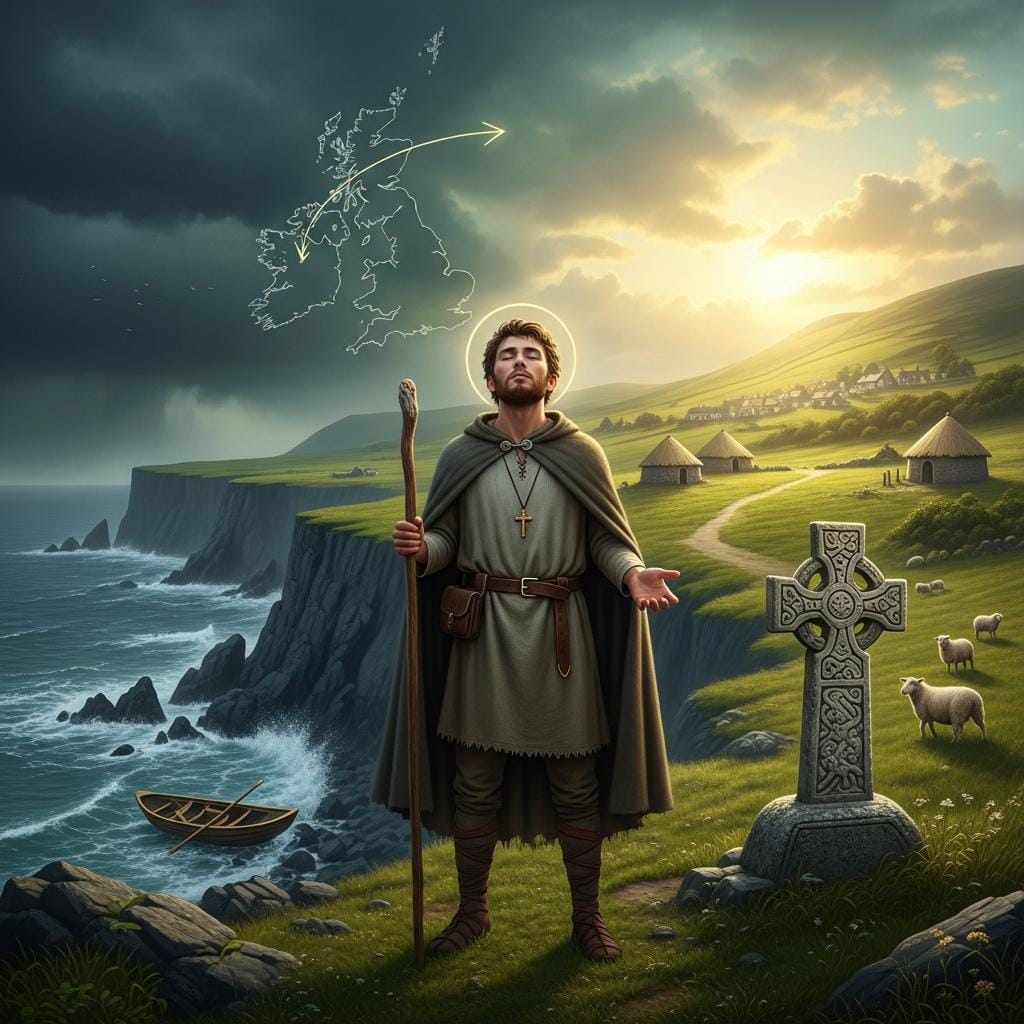
At the age of sixteen, Patrick’s world changed forever when Irish marauders raided his homeland, capturing him and other Britons. He was transported across the sea and sold into slavery far inland in pagan Ireland. For six years, Patrick tended sheep in harsh, lonely conditions. It was during these dark days that he turned to prayer, sometimes praying over a hundred times a day as he later wrote in his famous Confession of St. Patrick:
“After I arrived in Ireland, I tended sheep every day, and I prayed frequently during the day. More and more the love of God increased, and my sense of awe before God. Faith grew, and my spirit was moved, so that in one day I would pray up to one hundred times…”
Patrick believed his captivity was a result of turning away from God but found hope in returning to faith. He recalled the gentle urgings of his parents and resolved to seek God earnestly. One night, through a vivid dream, Patrick felt God’s assurance and promise of deliverance.
Escape and Call to Ministry
Following the dream where he heard a voice say, “Your ship is ready,” Patrick made a perilous 200-mile journey across Ireland to the coast, where miraculously a ship awaited. After difficult negotiations, Patrick convinced the captain to allow him aboard, escaping Ireland and returning to his family in Britain.
Reunited with his parents, Patrick devoted himself to studying Christian doctrine and training for ministry under Bishop St. Germain. For over a decade he prepared, but a new vision soon changed the course of his life forever. In another dream, Patrick saw a man named Victoricus bringing letters from the Irish people imploring, “We beg you, holy boy, to come and walk again among us.” This vision deeply touched Patrick and cemented his resolve to return to the land of his captivity as a missionary.
Patrick’s Mission to Ireland: Courage and Conflict
In 432 AD, against the advice of many and despite the danger of enslavement, Patrick returned to Ireland, determined to bring the Gospel to a society dominated by druidism, pagan traditions, and warlike chieftains. Patrick wrote, “I am ready to be murdered, betrayed, enslaved — whatever may come my way.”
Patrick’s mission met fierce opposition. The druids and nobility saw him as a threat. He was beaten, mocked, and even faced death several times, including a showdown with King Laoghaire and the druids on Tara’s hill. On his first Easter back in Ireland, Patrick courageously lit a Paschal fire in defiance of the king’s decree, symbolizing the light of Christ overcoming darkness. When brought before the king, Patrick’s witness and eloquence so impressed Laoghaire that Patrick’s life was spared, and he was allowed to continue his ministry.
The True Legacy: Church Planting, Social Reform, and Spiritual Renewal
Saint Patrick missionary to Ireland not only converted thousands but also established Ireland’s first Christian church at Saul, below Belfast. Over nearly three decades, he baptized over 120,000 converts, planted approximately 300–350 churches, and trained countless clergymen and missionaries—particularly empowering women in ministry as joint-heirs in faith, a radical departure from Druidic customs.
Patrick fervently advocated for the spiritual and physical well-being of all people. He boldly confronted warriors such as Coroticus, demanding the return of enslaved converts and warning of divine wrath for continued violence. Patrick’s writings, including his “Letter to the Soldiers of Coroticus,” demonstrate his deep love, advocacy, and willingness to face danger for his flock.
Patrick’s message was not just about individual salvation. Drawing on his years as a slave, he spoke out against slavery and the slave trade. He also introduced a new ethic of peace, kindness, and harmony among social classes and genders, slowly transforming the once-barbaric culture of Ireland.
There is neither Jew nor Gentile, neither slave nor free, nor is there male and female, for you are all one in Christ Jesus.
Galatians 3:28
Separating Fact from Legend
Many popular stories surrounding Patrick are myths—such as driving snakes out of Ireland (snakes were never native to the island), or using the shamrock to teach the Trinity (a much later invention). Likewise, Patrick was never canonized as a saint by Rome, though he is venerated across many traditions.
Patrick’s own works, the Confession of St. Patrick and the Letter to the Soldiers of Coroticus, written in rough Latin near the close of the fifth century, remain our best sources. Far from mere legend, these writings provide an intimate portrait of a missionary driven by profound faith, humility, and obedience to Christ’s command to “love your enemies and pray for those who persecute you.”
“You have heard that it was said, ‘Love your neighbor[a] and hate your enemy.’ But I tell you, love your enemies and pray for those who persecute you,
Matthew 5:43–44
The Peculiar Faith of the Celtic Church
Patrick’s legacy is intertwined with the early Celtic Church, known for its emphasis on Scripture, Sabbath-keeping, and a commitment to God’s law. This branch of Christianity, in contrast to prevailing traditions, advocated baptism by immersion and strict adherence to biblical teaching. The Celtic Church’s influence, led by Patrick, persisted until continental changes swept the island and shrouded many of its earlier practices in legend.
Saint Patrick’s Example for Today
The real Saint Patrick missionary to Ireland offers a model for Christian mission, faithfulness, and cultural engagement. His life was one of extraordinary love, perseverance, and hope—transforming a nation not by conquest but by the power of the Gospel. As new generations face a “post-Christian” world, Patrick’s courage to love his enemies and obey God’s call, despite personal cost, is a continuing inspiration for believers everywhere.
A Prayer for All Generations
Christ with me, Christ before me, Christ behind me, Christ in me,
Christ beneath me, Christ above me, Christ on my right, Christ on my left,
Christ when I lie down, Christ when I sit down, Christ when I arise,
Christ in the heart of every man who thinks of me, Christ in the mouth of everyone who speaks of me, Christ in every eye that sees me, Christ in every ear that hears me.
The courage and faith of Saint Patrick missionary to Ireland light a path for every Christian. His true story far surpasses the mythology, reminding us that a single, surrendered life can change the course of history.
Recommended Resources
- St. Patrick Biography—Core Christianity
- History of St. Patrick—Christian History Institute
- FREE From Elkleaf – TWO Versions: ‘Adult & Teen’ Version, plus ‘Kids’ Version
Coloring Pages for Saint Patrick’s Day based on the beautiful image above for this blog post.
For more about Scripture meaning, See our Book: 365 Popular Bible Verses and Their Meanings: Favorite Bible verses explained – a verse for every day of the year
Author

Discover more from Elkleaf Publishing
Subscribe to get the latest posts sent to your email.