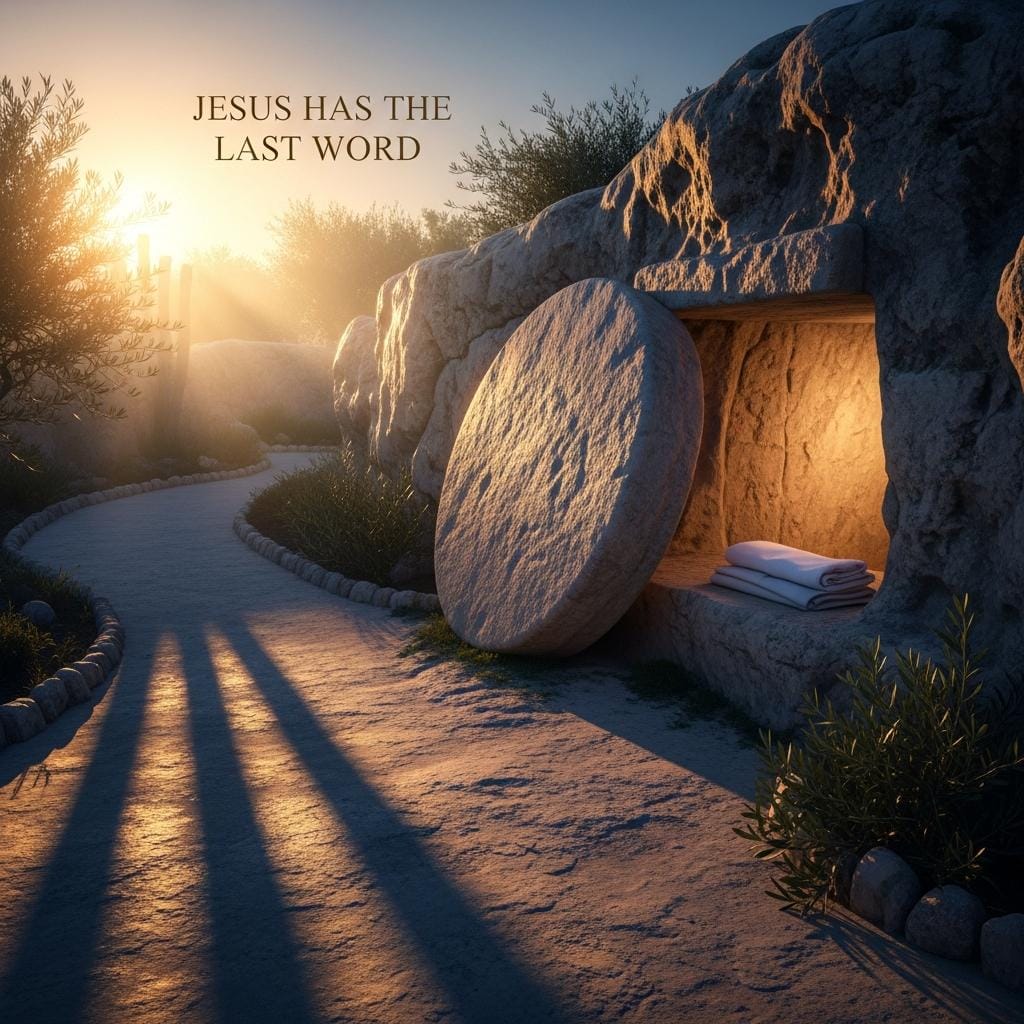
Jesus Has the Last Word: Resurrection Hope Over Satan, Fear, and the Grave
If you find this post helpful, please support these ministry efforts by buying a copy of my book: The Bible Made Simple and Easy: Book‑by‑Book Summaries of All 66 Books with Visual Aids and Key Verses. Available in the shop and on Amazon. Get your copy today!
The Last Word Isn’t What You Fear
Three voices love to threaten us with a supposed “final say.” Satan whispers, “You’re trapped in this struggle.” Fear insists, “You’ll never be bold.” The grave growls, “This is where the story ends.” But the Christian confession answers each counterfeit with one unshakeable declaration: Jesus has the last word. Because the tomb is empty, God meets us in trials, turns fear into courage, and gives us resurrection hope that outlives death itself.
1) When Trials Tether You to God
We don’t need to pretend that spiritual warfare and suffering are imaginary. Scripture is honest: there is an enemy, and life brings real wounds. Yet the Bible is even more honest about God’s sovereignty in suffering. Joseph, looking back on the betrayal that nearly destroyed him, could say, “You meant evil against me, but God meant it for good” (Genesis 50:20). The apostle Paul, asking the Lord to remove a “thorn,” learned instead that weakness was the pathway to strength (2 Corinthians 12:7–10).
Here’s the truth we often discover only in the dark: the struggle you want removed may be the very instrument God is using to keep you close. That isn’t glib optimism; it’s granite realism grounded in God’s sovereignty. Satan does not get the last word. The cross looked like the enemy’s checkmate—until Sunday came and revealed the checkmate belonged to Christ.
- Spiritual warfare is real, yet it operates on a leash. The Lord sets the boundaries and bends even opposition toward your sanctification.
- Purpose in pain is promised. You are not abandoned; you are being formed—refined, not discarded.
- Dependence is deliverance. As we learn to lean, we find His power is made perfect in our weakness.
If your current trial is shouting, “This is who you’ll always be,” answer with the voice of Easter: “Not so. God is at work, and Jesus is risen.”
2) From Fear to Faith: Anchored in a Real Resurrection
The disciples’ journey from hiding to heralding wasn’t motivational self-talk; it was encounter. They met the risen Christ. Luke records Jesus eating with them, opening the Scriptures, and sending them out (Luke 24). John tells of Thomas touching wounds that death could not keep (John 20). The book of Acts shows former cowards speaking with steel-spined courage in the face of threats (Acts 4).
Christian hope isn’t built on inspiring myth but on public, historical events. That matters in an anxious age. We’re not betting our lives on a vibe; we’re standing on the solid ground of a stone rolled away and a Savior who still speaks peace to fearful hearts. The result is forgiveness that clears our past and a mission that reshapes our future. Because Jesus is alive, our faith is not wishful thinking but a living allegiance that steadily replaces panic with proclamation.
If you tend to freeze in the face of cultural pressure, remember: fear doesn’t get the last word. The risen Christ does. We can confess Him with humility and clarity because He’s already carried our shame, secured our pardon, and promised His presence to the ends of the earth.
Consider these simple steps to move from fear to faith this week:
- Rehearse the resurrection accounts: read Luke 24 and John 20 aloud. Let the eyewitness details wash over you.
- Name one person who needs encouragement and gently share a recent way Jesus met you in weakness.
- Pray for boldness like the early church, not for a trouble-free path, but for courage to walk the path you have.
3) Hope That Outlives the Grave
Death speaks loudly in our world. Yet its roar is a bluff compared to the thunder of resurrection. Paul declares that if Christ has not been raised, our faith is vain; but because He has been raised, our labor is not in vain (1 Corinthians 15). To a grieving church, he writes not to “sorrow as others do who have no hope,” because Jesus’ victory guarantees our own (1 Thessalonians 4:13–18). Peter calls this a “living hope” anchored in Christ’s resurrection, securing an imperishable inheritance (1 Peter 1:3–5).
So, to the widow at the graveside, to the parent navigating an empty chair at dinner, to the friend who can’t shake the ache—hear this: the grave does not get the last word. Jesus does. That doesn’t cancel grief; it comforts it. Christian comfort is not denial; it’s defiance in the right direction. We grieve with hope, because the Lord of life has punched a hole through death from the inside.
Resurrection hope is both future assurance and present strength:
- Future assurance: Your destiny is not dust; it’s a renewed body in a renewed creation, with Christ at the center.
- Present strength: The same power that raised Jesus is at work in you now—sustaining faith, steadying hands, softening hearts.
4) Living the Resurrection Now: Practices for Real Life
Easter is not just a Sunday; it’s a season the Church has long savored—and a daily way of life. Here are practical, grace-driven rhythms to cultivate Christian hope that lasts:
- Pray your pain honestly: Tell God exactly where it hurts. Ask, “Father, how are You using this trial to draw me near?” Keep a brief journal of how He meets you over the next week.
- Preach the gospel to your fear: When anxiety spikes, repeat: “Jesus is alive. My future is secure. I am forgiven. I am sent.” Pair each phrase with a Scripture like 1 Peter 1:3–5 or Acts 4.
- Witness in weakness: Share one concrete way the Lord sustained you in a recent struggle. Authenticity beats polish; courage grows through use.
- Comfort the grieving: Show up with presence before you show up with words. Then, gently point to 1 Thessalonians 4:13–18 and pray together for resurrection hope.
- Resist the devil: When condemnation or accusation surfaces, answer it with the cross and the empty tomb. “You meant it for evil; God means it for good” (Genesis 50:20).
- Sabbath a headline: Once a week, fast from doom-scrolling and feast on a resurrection chapter like 1 Corinthians 15. Let the news that matters most reset the noise.
So, Who Has the Last Word?
Not Satan. Not fear. Not the grave. Jesus does. Because He is risen, your trials are not wasted, your fears are not final, and your grief is not god. The same Lord who turned a cross into a rescue and a tomb into a triumph is weaving your story toward glory. That’s not naïveté; that’s the logic of the gospel.
This week, choose one practice above and invite a friend to join you. Pray together. Read a resurrection text aloud. Encourage one another until courage sticks. The Easter hope we celebrate is the hope we carry—into our homes, our churches, our neighborhoods, and our weary world.
The empty tomb guarantees it: Jesus has the last word—over Satan, over fear, and over the grave. And in Him, so will you.
Scripture References
Author

Discover more from Elkleaf Publishing
Subscribe to get the latest posts sent to your email.