From Heart to Community: Quiet Habits for Church Unity
From Heart to Community: Quiet Practices That Build Church Unity
Jesus prayed for church unity, longing that His people would be one (John 17). The gospel creates a new community across every dividing line—a people whose identity in Christ surpasses all other labels (Galatians 3:28). But church unity doesn’t happen by accident; it grows when hearts are anchored in faith and contentment, when words are guided by listening and love, and when daily lives embody a humble witness—all while staying alert to the real adversary.
Start at the Heart: Faith Like Abel, Contentment That Settles the Soul
Before microphones and worship sets, there were two brothers and two offerings. Genesis 4 records Abel’s offering as accepted, while Cain’s was not. What mattered most was trust: by faith Abel offered a better sacrifice (Hebrews 11:4). Cain’s envy grew from striving—fuel for division since Eden.
In a world of comparison, church unity thrives with Abel’s posture. We worship with faith, not performance anxiety, and we find peace instead of envy. That peace blossoms into contentment: “Keep your life free from love of money, and be content with what you have, for he has said, ‘I will never leave you nor forsake you’” (Hebrews 13:5).
Unity grows when content hearts:
- Pray first, produce second. Ask, “Lord, am I coming in faith or fear? In trust or trying to prove?”
- Practice daily gratitude. Name three gifts today—write, say, and share them.
- Starve envy, feed joy. When someone is praised, join the applause. Your Father sees you.
Tune the Mouth: Empathic Listening and Guarded Speech
Church unity is rarely threatened by too much listening. Scripture says, “Let every person be quick to hear, slow to speak, slow to anger” (James 1:19). We honor people by attending to both spoken words and silent fears—true presence heals.
Yet speech can destroy: “The tongue is a fire” (James 3). Gossip may sound spiritual—“Share this so we can pray”—but it shreds reputations and sabotages relationships. “Whoever goes about slandering reveals secrets, but he who is trustworthy in spirit keeps a thing covered” (Proverbs 11:13). Listening deeply and guarding our words help church unity flourish.
- Listen to understand, not to reload. Ask two clarifying questions before responding (Proverbs 18:13).
- Adopt “verify before you amplify.” Don’t share if it’s unconfirmed, unkind, or unnecessary.
- Trade headlines for human stories. Before debating, ask, “How has this touched your life?”
- Practice the 24-hour rule. When upset, wait, pray, then respond with peace shaped by Scripture.
Let Your Life Speak: The Quiet Power of Example
Few will preach to thousands, but all are daily witnesses. A consistent example—keeping promises, serving without attention—preaches louder than words. Integrity in daily life transforms a church from a brand into an authentic community where church unity feels real.
- Begin at home. Align Sunday talk with Wednesday living—family will spot any disconnect.
- Honor God in the small. Make the call, serve behind the scenes, pray with others now, not “later.”
- Encourage as a reflex. Name and celebrate the good in others publicly.
Where integrity is the norm, church becomes a refuge of grace and truth.
Know the Battle: Recognize the Real Adversary
Scripture warns, “Your adversary the devil prowls around like a roaring lion, seeking someone to devour. Resist him, firm in your faith” (1 Peter 5:8–9). The real enemy is not each other but the evil one who delights in division and stirs trials into bitterness. Church unity thrives when we resist gossip and lies with truth and love.
- Rehearse the gospel. In Christ, you are forgiven and secure; unity doesn’t require winning every argument.
- Pray for those who frustrate you. Intercession makes slander far harder.
- Fight lies with Scripture. Prepare with verses—James 1:19, Proverbs 11:13, Hebrews 13:5.
- Confess quickly. If you fall into rumor or harshness, own it and restore unity.
Grace Holds Us Together: Unity Worth Protecting
Church unity isn’t uniformity. True unity celebrates Christ above every secondary identity. Paul urges, “Walk with all humility and gentleness, with patience, bearing with one another in love, eager to maintain the unity of the Spirit in the bond of peace” (Ephesians 4:1–6).
The cross created our unity. We guard it best with steady, simple practices:
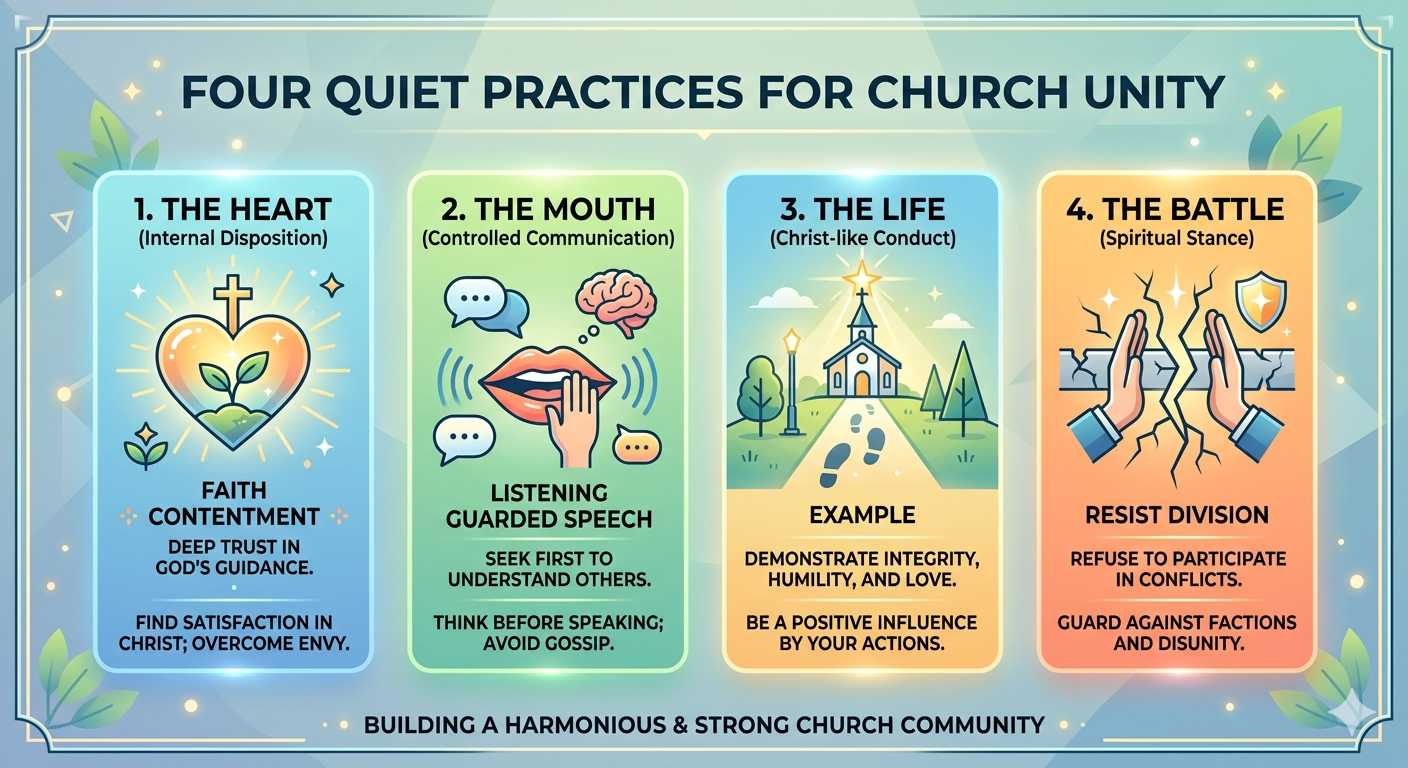
- Heart: Trust over striving; contentment over comparison.
- Mouth: Listen deeply, speak truth sparingly, refuse gossip.
- Life: Let your daily example testify to Jesus.
- Battle: Stay vigilant, resist the devil, and reject division.
Put It Into Practice This Week
- One prayer: “Father, give me Abel’s heart—a faith that trusts You and finds peace in Your presence.”
- One conversation: Ask a friend, “What’s been heavy on your heart?” Listen five minutes before responding.
- One boundary: No forwarding or posting without verification and necessity.
- One witness: Choose a quiet act of service no one sees; do it for the Lord.
- One verse to carry: Write 1 Peter 5:8–9 on a card; check your thoughts and tone with it.
Take Heart
Our hope is not in flawless execution, but in grace—the grace that forgives, fills us with the Spirit, and centers us on Jesus. As we trust God, seek contentment, listen with empathy, guard our speech, and live with integrity, our church unity becomes visible. In a noisy world, the quiet church—marked by faith, truth, and love—shines brightly for all to see.
See These Relate Post: Healthy Church: Make Jesus Non-Negotiable, People Over Programs: Christ-Led Church Health and Unity
Author

Discover more from Elkleaf Publishing
Subscribe to get the latest posts sent to your email.