Walk with God Daily: Trust, Suffering, and Reconciliation
If you find this post helpful, please support these ministry efforts by buying a copy of my book: The Bible Made Simple and Easy: Book‑by‑Book Summaries of All 66 Books with Visual Aids and Key Verses. Available in the shop and on Amazon. Get your copy today!
When “Why” Remains and Relationships Fray
If your week has been marked by a knot in your stomach—a hard “why, God?” you can’t untangle, or a relationship with a brother or sister that’s more ice than warmth—you’re not alone. Suffering brings uncertainty. Conflict brings distance. Both whisper the same lie: “You’re on your own.”
But the Christian answer begins somewhere brighter than our pain and stronger than our frustration: Jesus is alive. That single, stubborn fact reframes our days. Because Christ walked out of the tomb, we can walk with God today, trust Him when explanations don’t come, and take courageous, humble steps toward reconciliation.
The Foundation: Because Jesus Is Alive
Our faith isn’t spun from sentiment; it rests on history and eyewitness testimony. The early church staked everything on the resurrection as fact, not metaphor. Paul cites a living chain of witnesses to the risen Christ in 1 Corinthians 15:3–8, and Luke underscores “many proofs” in Acts 1:3.
If you need a refresher on the historical case, explore this accessible overview from Reasonable Faith: The Resurrection of Jesus. The point is pastoral as much as apologetic: evidence fuels assurance. Assurance strengthens courage. And courage empowers obedience when life gets complicated.
The Pathway: Walk with God Daily
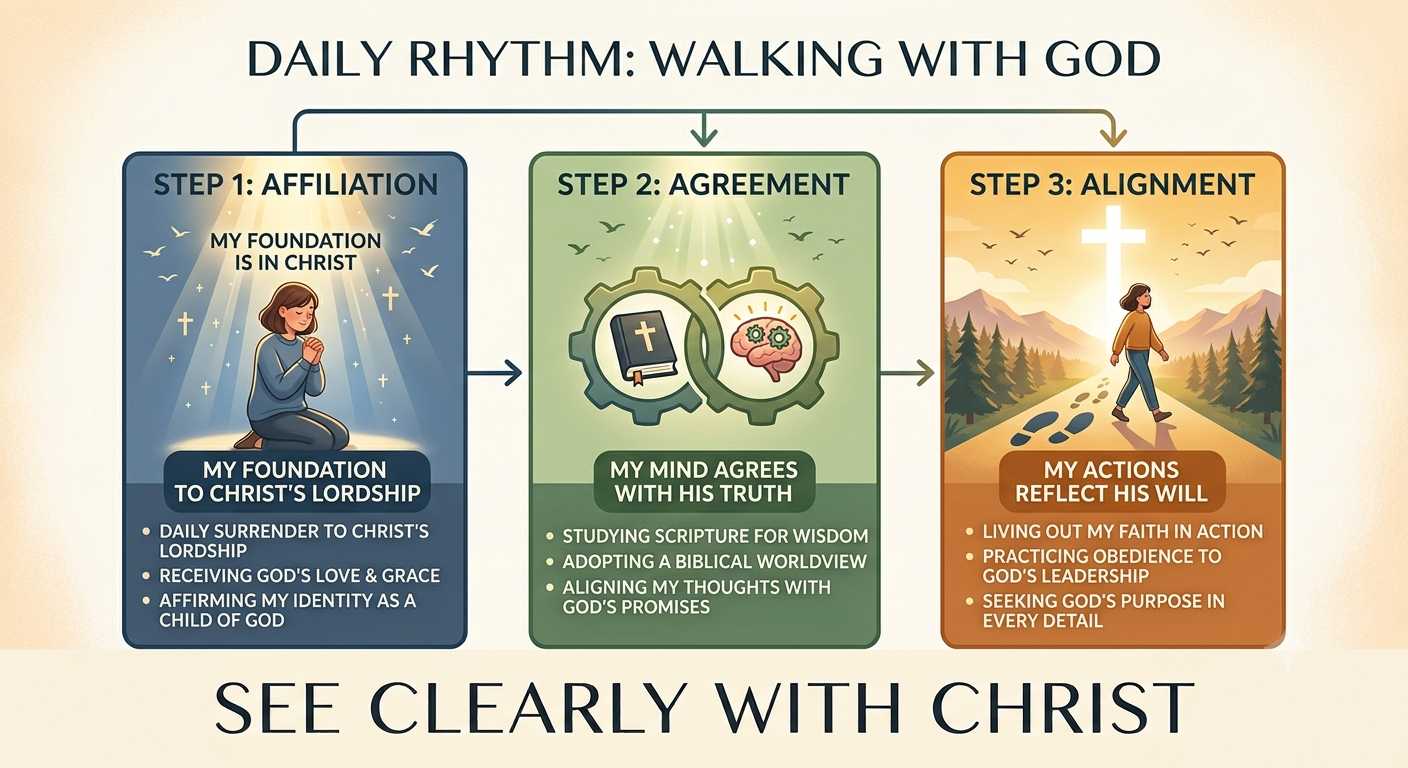
No one drifts into spiritual vitality. Scripture describes men and women who walked with God, like Noah (Genesis 6:9; Hebrews 11:7). Walking implies proximity, pace, and purpose. A simple framework can help:
- Affiliation — I belong to Jesus. Begin your day by confessing Christ’s Lordship and your identity in Him. A short prayer: “Father, I am Yours in Christ. Lead me by Your Spirit today.”
- Agreement — I agree with God’s Word. Two can’t walk together unless they agree (Amos 3:3). Read, receive, and resolve to obey—before the day throws you curveballs.
- Alignment — I adjust my steps to God’s ways. Micah calls us to do justice, love kindness, and walk humbly with God (Micah 6:8). Alignment means real decisions in real time.
Try a 10-minute morning rhythm for closeness and guidance:
- Minute 1–2: Breathe and acknowledge God’s presence. “You are here, and I am Yours.”
- Minute 3–6: Read a short passage (Psalms, a Gospel paragraph, James). Note one truth to agree with.
- Minute 7–8: Ask, “Where must my steps align today?” Name one action.
- Minute 9–10: Pray for courage and wisdom to walk it out.
Trusting God’s Higher Ways in Suffering
Some days offer no tidy answers. God’s timing and tactics can puzzle us. He told Israel, “My thoughts are not your thoughts… My ways higher than your ways” (Isaiah 55:8–9). Trust doesn’t mean shutting down honest questions; it means bringing those questions under the weight of God’s character and the certainty of the empty tomb.
When suffering presses the “why” button, move from reaction to response:
- Lament with faith. Pray your pain without pretense. The Psalms are filled with “how long?” and “why?”—yet they keep returning to God’s steadfast love.
- Ask for wisdom. Trials aren’t wasted when they produce maturity. James says God gives wisdom generously to those who ask (James 1:2–5).
- Remember the anchor. Jesus alive means goodness isn’t a theory; it’s a Person who conquered death and promises presence.
- Take the next step of obedience. You don’t need the blueprint to obey the next clear command—pray, serve, tell the truth, show up.
The journey from bitterness to trust rarely happens in a single leap. More often it’s a daily, even hourly, re-anchoring: “I do not see the ‘why,’ but I know Who holds me.” That re-anchoring is easier when we’ve already built a habit of affiliation, agreement, alignment in order to walk with God.
Pursuing Reconciliation with Courage and Humility
Faith is never only vertical. The God who reconciled us to Himself sends us to seek peace with others. Paul says we’ve been entrusted with the ministry of reconciliation (2 Corinthians 5:18–20). But reconciliation is hard work. Proverbs warns, “A brother offended is more unyielding than a strong city” (Proverbs 18:19).
When a relationship is frayed, move from defensiveness to peacemaking with a plan:
- Pray first. Ask the Lord for a heart to listen, a commitment to truth, and protection from pride.
- Plan the conversation. Choose a wise time and place. Consider writing your key points to avoid rabbit trails.
- Lead with listening. Invite their perspective: “Help me understand how you experienced this.” Reflect back what you heard before you respond.
- Own what’s yours. Confess specifically, without excuses. “I was wrong to do/say ____. Will you forgive me?”
- Speak the truth in love. If confronting, keep the goal restoration, not vindication. Use “I” statements, avoid labels.
- Seek a small next step. Suggest one tangible action that moves you both toward trust.
This is what daily alignment looks like in relationships: humility, vulnerability, and courage flowing from the assurance that Jesus is alive and at work. Your confidence isn’t in your conversational skills; it’s in the God who reconciles enemies at the cross, inviting all to walk with God.
Putting It Together: A Simple Next Step
Here’s a one-week practice to integrate walk with God, trust in trials, and reconciliation:
- Day 1–2 (Affiliation): Begin each morning declaring who you are in Christ. Read Micah 6:8 and ask, “Where will I need courage today?”
- Day 3–4 (Agreement): Meditate on Isaiah 55:8–9 and James 1:2–5. Write a short prayer of trust for your biggest “why.”
- Day 5–6 (Alignment): Identify one strained relationship. Prayerfully plan a peacemaking step using the bullet points above. Read Proverbs 18:19 and 2 Corinthians 5:18–20.
- Day 7 (Assurance): Rehearse the resurrection anchors: read 1 Corinthians 15:3–8 and Acts 1:3. Thank God for evidence that fuels faith and courage.
A Short Prayer
Father, thank You that Jesus is alive. Anchor my heart in His victory. Teach me to walk closely—affiliated with You, agreeing with Your Word, aligned to Your ways. When I don’t get the “why,” hold me steady in Your goodness. Give me courage and humility to pursue reconciliation where there is strain. Lead my steps today, and make me a peacemaker in the power of the risen Christ. Amen.
Keep Walking
The path ahead may still be foggy. But you’re not walking it alone. In Christ, your faith is rooted in a risen Lord, your steps are guided by His Word, your trials are shaping you, and your relationships can be restored. Walk with God. Trust in the dark. Make peace. The tomb is empty—and that changes everything.
Author

Discover more from Elkleaf Publishing
Subscribe to get the latest posts sent to your email.